This project translates research on spatial belonging and mental wellbeing among migrant youth in India into an open, participatory digital experience. Designed as an open system, it brings together lived narratives and spatial interventions to support reflection and engagement.
DETAILS
Scroll for more ↓

// CONTEXT
A post-pandemic research inquiry into how migrant youth in India experience spatial belonging and mental wellbeing.
During the pandemic, homes became sites where work, rest, and isolation converged. For many migrant youth in India, often living away from family in temporary accommodations, this shift intensified their relationship with everyday living spaces.
This project began as my graduation inquiry into spatial belonging - how people form emotional and identity-based relationships with the spaces they inhabit.
The outcome became The Dwellbeing Initiative, a systemic exploration of spatial living and care. This case study focuses specifically on Digital Dwellbeing, the UX-focused digital system within the larger initiative.
// DESIGN INTENT
How might we translate critical research into an accessible digital system that invites reflection and participation?
I led this project independently with support from an NID–Ford Foundation grant, working across research, system design, product design and UX.
Rather than simplifying spatial belonging into fixed solutions, the goal was to design a system capable of holding multiple perspectives and lived experiences. The platform was therefore conceived as an open and evolving structure that could surface narratives, translate research insights, and grow through participation.
// CRITICAL RESEARCH
Through intensive mixed methods research, spatial belonging emerged as a lived, emotional condition shaped by people, space, and everyday dwelling.
To explore how people relate to their living environments, I conducted a mixed-methods study combining literature review with surveys, interviews, spatial mapping, and contextual observation with migrant students across India.
To frame this relationship, I introduced spatial belonging as an exploratory lens describing how people form attachment, identity, and meaning through the spaces they inhabit.
Across the research, belonging emerged as relational rather than static shaped by multiple factors of influence. Post-pandemic homes in particular had become multi-role environments, intensifying both attachment and spatial tension.
A more detailed account of the research process, methods, and theoretical grounding can be viewed here.


< core guiding inferences >
// SYSTEMIC APPROACH
To make spatial belonging visible, relatable, and actionable, a system of interventions were envisioned.
The Dwellbeing Initiative was conceived as an ecosystem rather than a single artefact. Different touchpoints were imagined across digital and physical touchpoints, towards creating a system for holistic understanding and access.
Within this system, Digital Dwellbeing served as the digital layer: an open-access repository that could host narratives, surface theory in accessible ways, and evolve through participation over time.

< digital component of the experience >
Instagram functioned as a space to share evolving insights during the research process and observe which ideas resonated. It acted as a feedback loop, shaping how concepts were later translated into the website.

< Instagram posts for awareness >
// THE EXPERIENCE
Instead of discrete “components,” the website was designed as a set of interconnected experiences, allowing users to move fluidly between reflection, exploration, and action.
I intended the website to serve as a hub for learning about spatial belonging, through:
Spatial Stories - a place to foster spatial empathy by viewing how diverse people view the spaces they inhabit, and,
Ways of Space - a space for people to learn various practices they could implement within their own spaces towards wellbeing.

< mapping flows and wireframes >
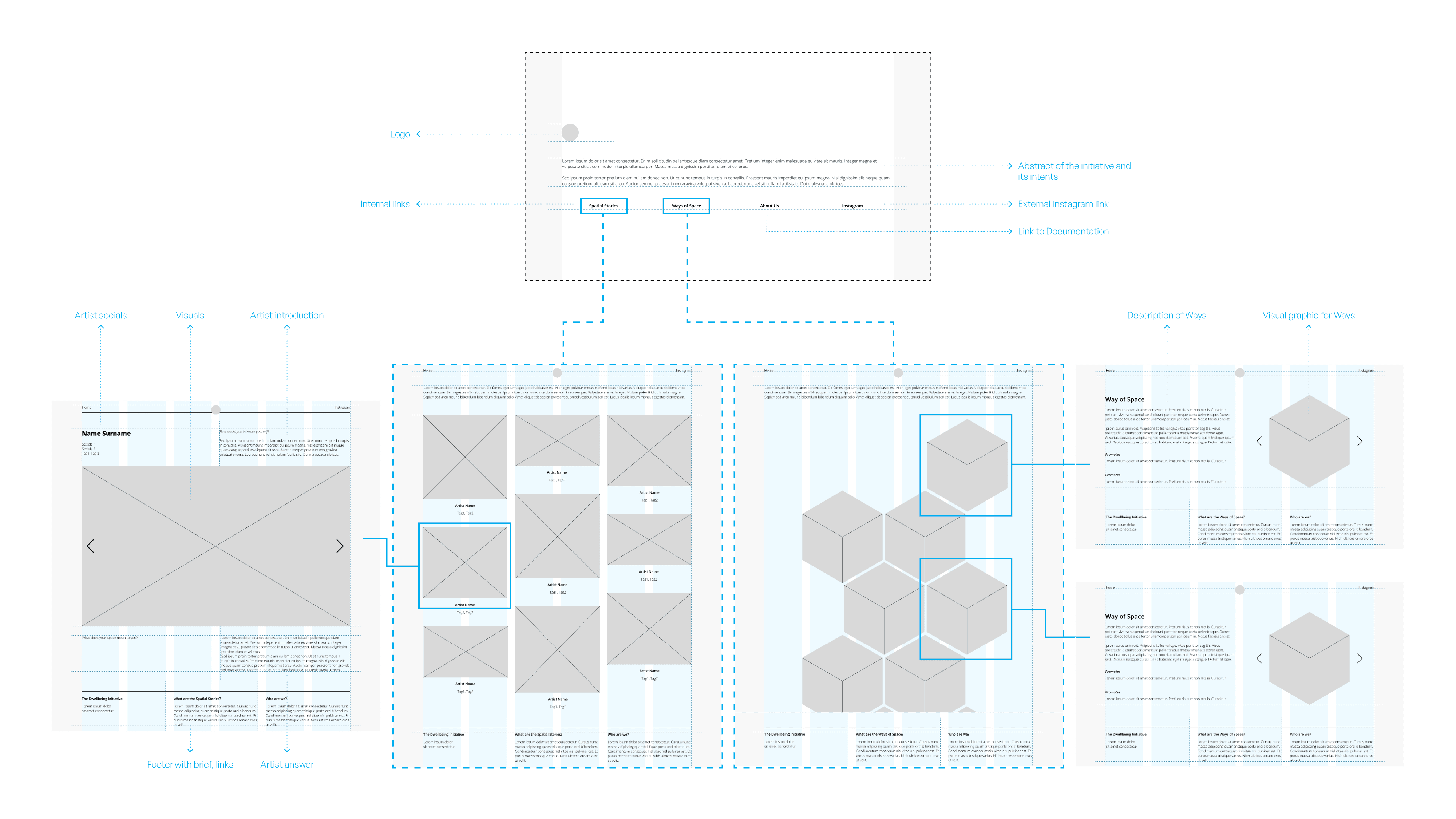
// THE EXPERIENCE // SPATIAL STORIES
An online exhibition of creative narratives exploring people’s relationships with space.
Spatial Stories is a curated digital repository of artworks, photo essays, journals, and other creative expressions that explore how people inhabit and relate to their spaces.
Rather than flattening experiences into themes, the design allows multiple, even conflicting, narratives to coexist - treating lived experience as a legitimate form of knowledge.


// THE EXPERIENCE // WAYS OF SPACE
A crowdsourced framework translating spatial theory into personalised, reflective interventions.
Ways of Space responds to a practical question that emerged from the research: how might people consciously shape their spaces to support wellbeing?
It exists both as a growing collection of spatial interventions and as a questionnaire-led experience that helps users generate a personalised set of “ways.” The questionnaire is framed as guided reflection, not diagnosis, encouraging awareness rather than instruction.


// OUTCOME
The system encouraged reflection, contribution, and reinterpretation.
Success for Digital Dwellbeing was defined qualitatively. People responded strongly to the diversity of spatial perspectives shared through the platform. Several participants expressed interest in contributing their own experiences and practices.
This led to new additions within Ways of Space, reinforcing the platform’s role as an evolving repository rather than a fixed resource.
// REFLECTIONS
This project shaped how I design systems that hold care, ambiguity, and participation.
This project reshaped how I approach research-led design. Rather than resolving complex human experiences into singular solutions, I began exploring how design can create open systems that people interpret and shape over time.
These ideas continue to inform how I approach UX and product design today, particularly in projects involving community, identity, and wellbeing.